ElevenLabs Free Plan vs a Local Open-Source Model: Same Chinese Script, Side by Side
I ran one 184-character Chinese script through ElevenLabs' free plan and through Qwen3-TTS on a laptop with no GPU, then compared misread words, pauses, speed and how natural each version sounded.
Cover logos from the ElevenLabs press kit and the official Qwen3-TTS repository. Trademarks belong to their owners.
Key takeaways
- By ear, ElevenLabs' stock Mandarin voice Jason Chen sounded the most like a real person. My local voice clone sounded the least natural.
- ElevenLabs returned two 35-second takes in under 8 seconds. The local model needed about 3 minutes per take on a CPU.
- The local preset voice read the English name Muse the Chinese way every time it came up. ElevenLabs kept it in English.
- Chinese is cheap on the free plan: 184 characters cost 184 credits for two takes, so the 10,000 monthly credits cover roughly half an hour of Chinese speech. The free plan does not allow commercial use.
On this page
My voice-cloning article ended with an open question: would a paid service do better than the free model on my laptop? This time I ran the same script through ElevenLabs’ free plan and through Qwen3-TTS, then compared the results with a script and with my own ears.
The test
The script is five lines from one of my explainer videos, 184 Chinese characters in total, about connecting an AI assistant called Muse to the Feishu chat app. It has commas, a colon, a list separated by 、 and the English word Muse four times. Those are the places where narration usually goes wrong.
On ElevenLabs I used the free plan with the default model, Eleven v4, and default settings (stability 50%, similarity 75%). I filtered the voice library to Chinese, sorted it by number of users, and picked the most-used Beijing-Mandarin male voice, Jason Chen (83.7K users), plus a female voice, Amy (38.6K users).
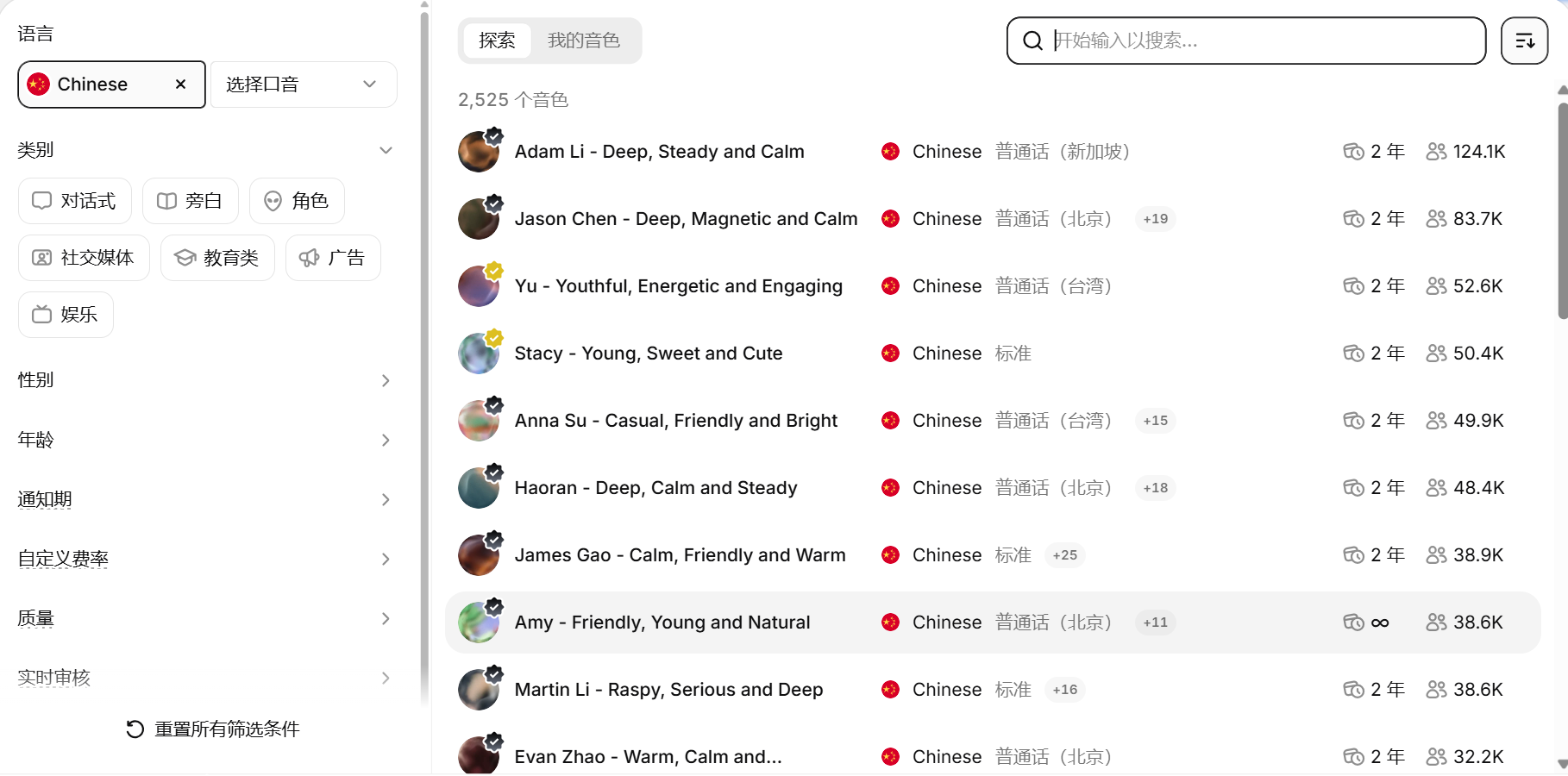
Every click on Generate returned two versions of the whole script.

On the laptop I used two Qwen3-TTS voices. One was the built-in preset voice dylan from the CustomVoice model, told to speak standard Mandarin like a tech news anchor, generated twice. The other was my own cloned voice from the previous article, using the best takes I had picked back then.
That makes seven versions: four from ElevenLabs, two from the preset voice and one from my clone.
How I compared them
A script measured each version. A speech recognizer (Paraformer) turned the audio back into text to catch misread words. The script also counted clear pauses of 0.15 seconds or more and compared them with the 20 or so punctuation marks inside the text, and it measured speaking speed and how much the pitch moves.
Then I listened to all seven versions back to back and ranked them.
Results
| ElevenLabs Jason Chen | ElevenLabs Amy | Local preset voice (dylan) | Local clone of my voice | |
|---|---|---|---|---|
| Time for about 35 s of speech | Under 8 s for two takes | Under 8 s for two takes | About 3 min per take | About 3 to 6 s per second of speech |
| Misread words | None | Possibly one, in take 2 | Muse read the Chinese way every time | None |
| Clear pauses (about 20 expected) | 20 | 18 to 19 | 15 to 16 | 11 |
| Speed (characters per second) | 5.6 | 5.7 | 4.9 to 5.2 | 6.0 |
| Pitch movement (semitones) | 4.1 | 4.3 to 4.5 | 5.9 to 7.0 | 3.0 |
| My ranking by ear | Most natural (take 2) | Middle | Second to last | Last |
The recognizer wrote 他 instead of 它 in every version. Both are pronounced tā, so I did not count that as an error.
What stood out
The local preset voice could not handle the English word in a Chinese sentence. With the language set to Chinese, it read Muse as something like “miù zi” or “miù sī” (the recognizer wrote 缪子 and 缪斯) in all eight places across its two takes. ElevenLabs and my clone kept it as the English word. If your Chinese scripts contain English product names, test this before anything else.
ElevenLabs paused at almost every punctuation mark: 20 clear pauses for Jason Chen, 18 to 19 for Amy. My clone had the fewest pauses and the fastest pace, so it ran through many commas without stopping. It is also the version I ranked last. The numbers alone can’t say why it sounded worst, but it was the clear outlier on pauses.
Pitch movement was highest for the local preset voice and lowest for my clone, with ElevenLabs in between. The two extremes, most and least pitch movement, were the two versions I ranked lowest.
In Amy’s second take the recognizer heard 在机器人 where the script says 开机器人. That could be a slip in the audio or a recognizer mistake.
ElevenLabs was also much faster. It produced two takes of the whole script in under 8 seconds, while the local model on my CPU needed 176 to 184 seconds for one take of the same length.
Cost and limits of the free plan
Each generation of the 184-character script cost 184 credits and returned two versions. The free plan gives 10,000 credits a month. ElevenLabs’ pricing page estimates about 10 minutes of speech for that, but Chinese packs more speech into each character. In my test 184 credits made about 35 seconds of audio, which works out to roughly half an hour of Chinese a month.
The free plan does not include a commercial license, which is also why there are no ElevenLabs audio samples in this article. It has no voice cloning either. Instant Voice Cloning and the commercial license start with the Starter plan, which costs $6 a month (the first month was $1 when I tested, with the offer ending November 8).
Which one to use
ElevenLabs’ stock Mandarin voices gave the most natural narration in this test, and they were far faster. The free plan is enough to try them on your own scripts. For videos you earn money from, you need the Starter plan or higher.

Online AI voice generator with a large voice library, including 2,500+ Chinese voices.
Gave the most natural Chinese narration in my side-by-side test, in seconds. The free plan is enough to try it, but it has no commercial license and no voice cloning.
- Stock Mandarin voices sounded the most natural in my test
- Two 35-second takes in under 8 seconds
- Chinese uses few credits: about half an hour a month on the free plan
- Free plan: no commercial use and no voice cloning
- Text and audio are processed in the cloud
- One take may have misread a word
The local model still makes sense if you want your own voice without paying, need everything to stay on your computer, or generate a lot of audio. Expect slow generation, some setup, and English words inside Chinese text to need checking.
What I didn’t test
I only used ElevenLabs’ default model and settings, two of its 2,525 Chinese voices, and one short script. I did not test ElevenLabs’ voice cloning, because it is not on the free plan.
Tools in this article
Online AI voice generator with a large voice library, including 2,500+ Chinese voices.
Gave the most natural Chinese narration in my side-by-side test, in seconds. The free plan is enough to try it, but it has no commercial license and no voice cloning.
- Stock Mandarin voices sounded the most natural in my test
- Two 35-second takes in under 8 seconds
- Chinese uses few credits: about half an hour a month on the free plan
- Free plan: no commercial use and no voice cloning
- Text and audio are processed in the cloud
- One take may have misread a word

Open-source text-to-speech model from Alibaba's Qwen team. It can clone a voice from a short recording.
Good enough for my video narration once I switched to x-vector mode. Free, but slow on a CPU and it needs a Python setup.
- Free, runs on your own computer
- Works on a laptop with no GPU
- Fluent narration in x-vector mode
- About 3 to 6 seconds of computing per second of speech on a CPU
- Needs Python and some setup
- Sometimes misreads Chinese characters that have several readings
- Sounded less natural than ElevenLabs in a side-by-side listen